

Introduction
In today’s hyperconnected world, loneliness has emerged as a growing concern across all age groups. Many people assume loneliness only affects those who live alone or have few social contacts. However, a person can feel deeply lonely even while surrounded by family, friends, or colleagues.
Recent media reports suggested that India ranked among the world’s loneliest countries. While these reports have sparked important discussions, there is currently no official global ranking maintained by international organisations such as the World Health Organisation (WHO).
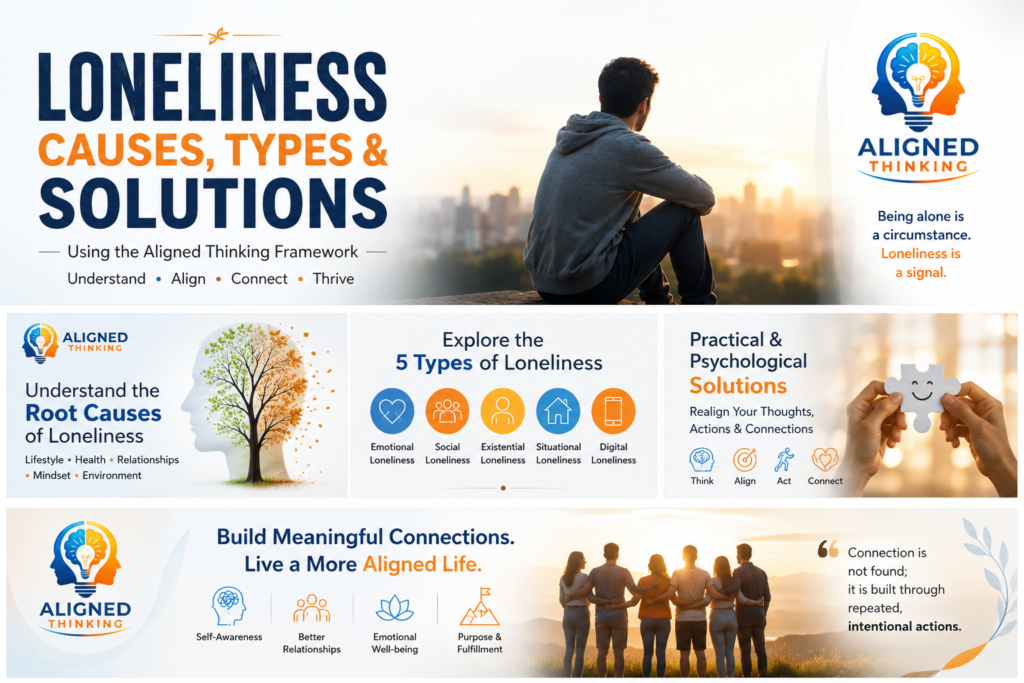
What experts agree on is this:
Loneliness is becoming a major public health challenge worldwide, affecting emotional, mental, and physical well-being.
This article explores the different types of loneliness, their root causes, and practical strategies to overcome them, drawing on psychological insights and the Aligned Thinking framework.
Is India the Second Loneliest Country in the World?
Recent surveys shared by media outlets have suggested that India ranked second among 36 countries studied for loneliness levels. However, it is important to understand that these findings come from private surveys rather than official global health databases.
Currently, organisations such as the World Health Organisation (WHO) and the United Nations do not publish an official global loneliness ranking.
The key takeaway is simple:
Whether or not India ranks second, loneliness is a growing issue that deserves attention and action.
What Is Loneliness?
Loneliness is not the same as being alone.
Being alone is a physical state, while loneliness is an emotional experience that occurs when the quality or quantity of social connections does not meet a person’s needs.
Simple Definition:
Loneliness occurs when the connection a person needs is greater than the connection they experience.
The Five Main Types of Loneliness
1. Emotional Loneliness
This occurs when a person lacks a deep emotional bond or a trusted relationship.
Common signs:
- Feeling empty despite having family or friends
- Missing a close companion
- Feeling misunderstood
2. Social Loneliness
This happens when someone lacks a broader social network.
Common signs:
- Few meaningful friendships
- Limited social activities
- Feeling disconnected from a community
3. Existential Loneliness
This type involves feeling disconnected from life’s purpose or meaning.
Common signs:
- Feeling that no one truly understands you
- Questioning your purpose
- Experiencing inner emptiness
4. Situational Loneliness
This develops due to life changes or transitions.
Common triggers:
- Moving to a new city
- Retirement
- Breakups
- Job loss
- Loss of a loved one

5. Digital Loneliness
This occurs when online interactions replace meaningful human connections.
Common signs:
- Excessive social media use
- Constant scrolling
- Feeling disconnected despite being online
What Causes Loneliness?
Loneliness rarely has a single cause. It usually develops through a combination of lifestyle, emotional, health, and environmental factors.
1. Lifestyle Factors
Modern lifestyles often reduce opportunities for meaningful human interaction.
Common lifestyle causes include:
- Excessive social media use
- Long working hours
- Remote work without social interaction
- Sedentary routines
- Lack of hobbies or community involvement
- Poor work-life balance
2. Major Life Changes and Personal Setbacks
Certain events can increase feelings of isolation.
Common triggers include:
- Divorce or separation
- Death of a loved one
- Academic failure
- Business or career setbacks
- Retirement
- Relocation or migration
Failure itself does not cause loneliness. The withdrawal, shame, and fear of judgment that often follow can create emotional distance from others.

3. Physical and Mental Health Conditions
Health challenges can make it harder to connect with others.
Mental health factors:
- Depression
- Anxiety disorders
- Chronic stress
- Trauma
- Low self-esteem
Physical health factors:
- Chronic pain
- Sleep disorders
- Reduced mobility
- Hearing or vision difficulties
- Long-term illnesses
4. Economic and Financial Challenges
Financial stress can significantly impact social well-being.
Examples include:
- Unemployment
- Debt
- Low income
- Housing insecurity
- Long working hours due to financial pressure
5. Relationship Challenges
People can feel lonely even when surrounded by others.
Contributing factors include:
- Family conflict
- Lack of emotional support
- Superficial friendships
- Poor communication
- Feeling misunderstood
6. Personality and Thinking Patterns
Certain thought patterns can unintentionally increase loneliness.
Examples include:
- Fear of rejection
- Perfectionism
- Excessive independence
- Negative self-talk
- Overthinking
- Unrealistic expectations

7. Social and Cultural Changes
Modern society has transformed how people connect.
Key factors include:
- Urbanization
- Smaller families
- Frequent relocation
- Increased screen time
- Reduced neighborhood interaction

How Does Loneliness Affect Mental and Physical Health?
Persistent loneliness can affect overall well-being in several ways.
Emotional Effects
- Sadness
- Irritability
- Low motivation
- Reduced self-esteem
Mental Effects
- Increased anxiety
- Depression
- Difficulty concentrating
- Negative thinking patterns
Physical Effects
- Sleep disturbances
- Fatigue
- Reduced immunity
- Increased stress levels
Psychological Strategies to Overcome Loneliness
Prioritise Quality Over Quantity
Focus on building meaningful relationships rather than increasing the number of contacts.
Create Consistent Social Rituals
Examples include:
- Weekly family dinners
- Morning walks
- Community groups
- Hobby classes
Reduce Passive Screen Time
Replace scrolling with active communication.
Try this simple rule:
For every 30 minutes spent online, spend at least 10 minutes connecting with someone offline.
Practice Deeper Conversations
Move beyond surface-level interactions.
Ask questions like:
- What inspired you today?
- What challenge are you facing right now?
- What are you looking forward to this week?
Seek Professional Support When Needed
If loneliness significantly affects daily life, relationships, sleep, or work performance, consider speaking with a qualified mental health professional.
The Aligned Thinking Framework for Overcoming Loneliness
The Aligned Thinking approach views loneliness as a gap between:
Reality → Expectations → Actions
When these three elements become misaligned, feelings of loneliness often increase.
Step 1: Identify the Missing Connection
Ask yourself:
- What kind of connection am I seeking?
- What expectations do I have of others?
- Are my actions aligned with my expectations?
Step 2: Shift From Waiting to Creating
Replace:
“People should understand me.”
With:
“Meaningful relationships grow through clear communication and consistent effort.”
Step 3: Focus on Contribution
Instead of asking:
“Who cares about me?”
Ask:
“Whose life can I positively impact today?”
Step 4: Build a Weekly Connection System
Every week, aim for:
- One meaningful conversation
- One shared activity
- One act of kindness
- One community interaction
Step 5: Measure Connection, Not Popularity
Success is not measured by:
- Number of followers
- Number of contacts
- Number of likes
Success is measured by:
- Trust
- Support
- Meaningful interactions
Frequently Asked Questions (FAQ)
Is loneliness the same as being alone?
No. Being alone is a physical state, while loneliness is an emotional experience.
Can social media increase loneliness?
Yes. Excessive passive scrolling can create digital loneliness by replacing meaningful interactions with superficial engagement.
Can successful people experience loneliness?
Absolutely. Loneliness affects people across all income levels, professions, and age groups.
Is loneliness a mental illness?
No. Loneliness itself is not a mental illness, but long-term loneliness can increase the risk of depression, anxiety, and other mental health challenges.
What is the fastest way to reduce loneliness?
Start with one intentional action each day, such as calling a friend, joining a community group, or participating in a shared activity.
When should I seek professional help?
If loneliness persists for several months and affects your sleep, work, motivation, or relationships, consider consulting a mental health professional.
Conclusion
Loneliness is not a sign of weakness, failure, or personal inadequacy. It is a signal that an important human need for connection is not being met.
The good news is that loneliness can be addressed through awareness, intentional action, and meaningful relationships.
Remember:
Being alone is a circumstance. Loneliness is a signal.
The Aligned Thinking framework teaches us that a lasting connection is created when our expectations, actions, and reality work together.
Instead of waiting for the connection to happen, take one small step today to create it.
Because meaningful relationships are not found by chance—they are built through consistent, intentional effort.

RAM Sir (Ramakant Nevse) is the founder of Digital Traffic Academy and creator of the Aligned Thinking model. He helps individuals, professionals, and businesses achieve clarity, improve decision-making, and leverage AI and digital marketing for personal and professional growth.